The Gatekeeper · WordPress security

Stop attacks before WordPress even starts.

A front door for your clients’ WordPress sites. Bad requests are refused before PHP, plugins or the database ever load so visitors get the page and editors still get in.

Not another plugin. A small gate in front of WordPress.

One live site · 23 days

Seventeen thousand attacks, stopped before they cost the website anything.

Editors still got in. Visitors still got the page.

0
Decisions made

by the gate in 23 days

0
Stopped before PHP

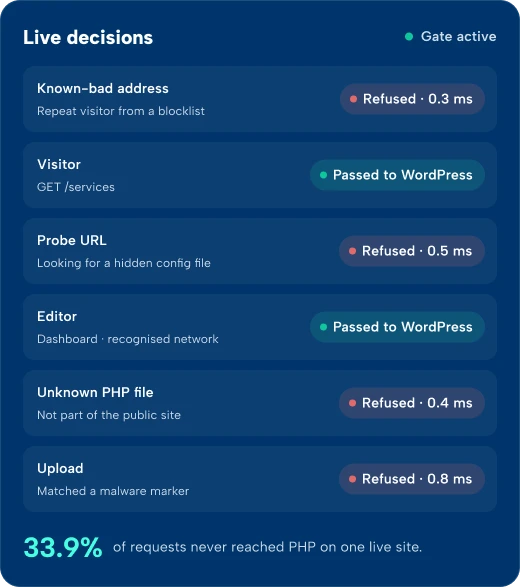
33.9% of all requests

0
Addresses refused

distinct sources turned away

0
In the worst minute

stopped in 60 seconds

Measured on one production WordPress site, 26 April – 21 May 2026 (23 logged days).

Why plugins aren’t enough

Security plugins start too late.

A plugin firewall runs inside WordPress. By the time it says no, the server has already paid for a PHP worker, a WordPress boot and a database connection — even for a 404 or a probe. Log-based banning is later still: it reads the request after it happened.

The usual stack

≈ 80 ms CPU per request

Request
PHP worker
WordPress boot
Security plugin
Blocked

Every refused request still costs about 80 ms of CPU and 180 ms of PHP worker time on a small server (model estimate).

With The Gatekeeper

0.3–0.8 ms per decision (measured)

Request
PHP worker
WordPress boot

Refused in front of WordPress. PHP never starts, so the server stays free for real visitors and editors.

What you get

Four parts. One product.

Everything your agency needs to keep client WordPress sites safe — and to explain what happened when someone asks.

The gate

Bad addresses, probe links and bad uploads stop at the door. Normal pages walk through.

01

Sentinel

An AI that explains the odd cases in a sentence, so your team can tell a client what happened without reading a log.

02

The scanner

Checks every kind of file, and looks inside zip files. Other scanners we tried do not do that properly.

03

Ask the server

Your assistant can ask what was blocked today, without handing out the keys to the machine.

04

The minute that pays for the product

2,386 requests in 60 seconds. None reached WordPress.

9 May 2026, 08:17 UTC. If those requests had reached PHP with a typical security plugin, that one minute would have needed about 3.2 CPU cores and 7 PHP workers. A 1 vCPU plan doesn’t have 3.2 cores — real visitors would have waited.

Other peaks: 511 in one minute on 21 May · 372 on 5 May · 331 on 11 May.

3.2 cores

of CPU avoided in that minute*

7 workers

kept free for real visitors*

99.7%

of that hour never entered WordPress

*Model estimate: about 80 ms of CPU and 180 ms of PHP worker time per request.

Nothing breaks for real people

We didn’t make the homepage cheaper. We stopped the junk competing with it.

52,440 requests over 23 days

One live site

33.9% stopped at the gate
66.1% passed to WordPress — visitors, editors, cron

17,769 requests never reached PHP. The other 34,671 — real visitors, editors, scheduled jobs and probes not yet on a list — were served by WordPress as normal.

Visitors get the page

Public pages never call the access registry. They render in WordPress, exactly as before.

Editors still get in

4,039 admin requests allowed after a live check, 50 refused from unrecognised networks. Repeat clicks are cached briefly.

Scheduled jobs keep running

Cron is never gated: 2,909 scheduled runs went straight through.

Faq

Questions agencies ask.

Why not just use a security plugin?

A plugin runs after PHP has started. On this site, 17,769 requests never got that far. Keep the plugin if you want a second opinion. It is not the front door.

That reads the log of a request that already happened. About 9 seconds of its own CPU versus about 24 CPU-minutes of PHP, and 3 cores in the worst minute.

Public pages are not checked. 4,039 admin visits were allowed and 50 were refused, from networks the gate did not trust. Repeat admin clicks stay quick.

The gate adds about 2.1 milliseconds and uses about 0.5–2% of a CPU. A normal page still loads in WordPress. People do not feel the door.

No. The layout and the lists we operate are the product.

No. The door is rules and lists, and it is fast. The AI explains the odd cases. It does not sit on every page view.

The scanner opens archives and checks the files inside. That is the gap we kept hitting in other scanners.

No. One in three requests on this site were junk, and those never reached WordPress. Real pages still use the server. The number that matters is the bad minute: 2,386 hits in 60 seconds, answered before PHP started.

Yes. It becomes the second look. The gate is the first.

One live WordPress site, three weeks in April and May 2026. The request counts are from that log. The 2.1 ms and the 0.5–2% CPU are the gate’s own footprint. The minutes of PHP are what those hits would have cost if they had been let through.

Put the gate on your
next client site.

Start with a pilot on your own traffic, before you install another plugin to do the same job from inside WordPress.